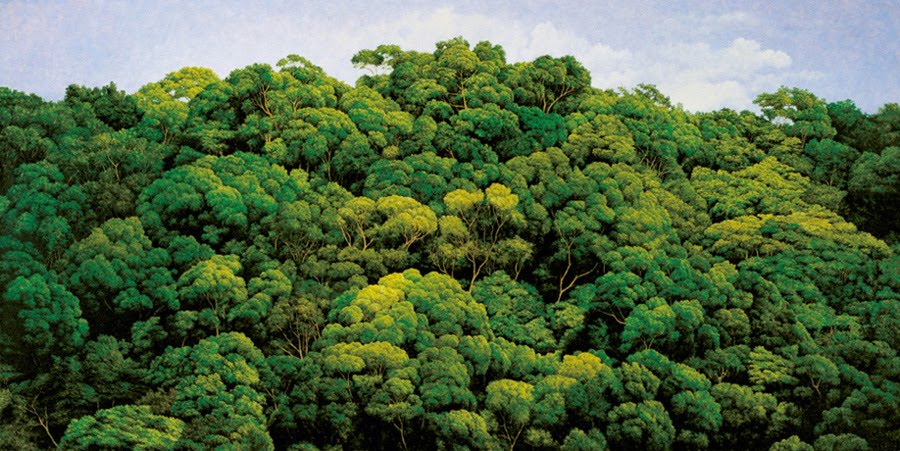
The Whispering Trees
4 Comments
»
Darren Almond is a London based photographer/ artist that I like. His pictures offer a lonely viewpoint of inhospitable lands. Hidden vistas closed to man, where there is no touch of our hand on the landscape, places where we can only pass hurriedly through. Huge elemental places that make a mockery of our tiny lifespans and fragile egos.
Cold and lonely, they seem to operate in a similar, less kitsch way to the melancholy germanic folklore of Caspar David Friedrich - most of his stuff is cloyingly twee, but below is a painting that I love as it, more than any other painting I can think of, conjours up how I imagine the desolate, sad and shattered wastes of Frankenstein's Monster. Which has to be my favourite, least favourite place to imagine in all the books I have ever read.

What an amazing drawing of a fly(click to enlarge), managing to look both old and futuristic, natural and entirely robotic at the same time. Which ties in nicely with my current interest in bio-organic design. Taken from the 1857 Julius Victor Carus book on invertebrate animals: 'Icones Zootomicae, die Wirbellosen Thiere'

There's a very dedicated chap called Martin Klatsch who compiles various selections of kitsch pictures. Here he has gathered a collection of images from old 1970's danish pornographic magazines, paying attention to the decor rather than the action, the images are safe for work...

I just stumbled across this artist, called Paul Davies, from Sydney Australia. I like the way he combines acid-washed moody painting with a graphic theme and cool architecture, sort of an even more trendy Peter Doig. I shall be looking out for more of his work!

Here are Beautiful engravings of corals, drawn by zoologist, lepidopterist and naturalist, Eugenius JC Esper (1742-1810)
The present work is entitled 'Die Pflanzenthiere in Abbildungen nach der Natur mit Farben erleuchtet nebst Beschreibungen' (something like: Natural animal-plants in colour with enlightened commentary) that was first published in ~1791.
This particular coral reminds me very strongly of a wasp's nest, and led me to wonder on the recurrence of shared patterns in nature

I really like this Japanese artist's work for some reason, although it looks like he's been heavily influenced by Chris Cunningham. Cool stuff

Original dazzle camouflage designs that have been added to the
Rhode Island School of Design website
dazzle:
Created by artist Norman Wilkinson, dazzle was very popular in WW1, and to a lesser extent in WW2. Dazzle was not meant to camouflage the ship in a conventional sense, but to create an optical illusion, making it hard for observers using naval rangefinders to gauge the size of the vessel and the speed & direction it was headed, making them harder to be hit by naval artillery.
Apparently there is great debate as to whether the dazzle had much effect, most agreed that it was rather uneffective against submarines, but there was great credence put on the morale boosting power to the troops of seeing such large and lethal machinery bedecked in such exciting patterns and colours. It also increased the morale of people not involved in fighting; hundreds of wonderfully coloured ships in dock was like nothing ever seen before or since.

Funny how so many people of my age and younger have a nostalgia for the postwar years, when we were yet to be born until another 30 long years later!
This brief window of time after WW2 as the sun set over Albion was captured in beautiful fashion by the photojournalist John Gay, a German. Born Hans Gohler in 1909, he fled the country in 1933 for a new life in Britain, horrified by the treatment of his Jewish friends at the hands of the Nazi regime, and served in the Pioneer Corps during the Second World War. His favourite subjects were the English countryside, London street scenes and the architecture of the railways, the latter leading to a book collaboration with Sir John Betjeman.
"...His photographs capture people going about their everyday lives and they are special because he was looking at Britain through foreign eyes..."
John Gay - England Observed runs from January 29 - March 29 at Kenwood House, Hampstead. Admission is free
Collection of Photographs
OBITUARY: JOHN GAY

He used 30,000 matches to complete the 15-inch high gorilla head.
They are crafted by firstly making a clay mould of the head and creating a fibreglass or plastic version from it.
The matchsticks are then stuck on using wood glue.
Each work sells for between 20,000 pounds and 35,000 pounds.
Banksy in 'really quite intelligent slogan' shock!
Definately simplistic - art for people who don't "get" art... (advertising?)
but this did at least make me smile
from Art News Blog






 Subscribe by RSS