Going...going...

A list of things that arn't very old that 20 somethings probably wouldn't even know about:
Ned's Atomic Dustbin
The Orb
The Charlatans
The Levellers
The Smashing Pumpkins
Suede
The KLF
The X files
The Shamen
Mark Morrison
Portishead
Generation X
The Lemonheads
Sky Magazine
Sandra Bernhardt
River Phoenix
The Farm
Father Ted
Alan Partridge
The Word
Game On
Terry Christian
Twin Peaks
Beavis and Butthead
Eva Herzigova
Eldorado
...not saying I liked many of them (I HATED the Levellers), just that I can imagine plenty of kids who are 20 now who were 5 or 6 at the time and wouldn't know anything about this stuff. I'm sure Ned's Atomic Dustbin must be due a comeback by now
Fading fast

Over here, Gaw talks about the march of time and the fading of shared experiences. I was thinking about something on a similar theme only this week, as I stood in an excellent pub with my father as he held court with his cronies.
We all know pubs are dying, thats a given, and people of my generation seem to be as upset about it as everyone else. But it's a fact that people of my age group simply don't use the pub as older people do. For men of my father's age, the pub is an automatic destination. Staying the night in a strange town? Sniff out a welcoming looking hostelry and chat with some locals at the bar. This is so instinctively done that I honestly think if you asked him he would say that it's not something he would think about, it's just something you do.
For people of my age group who are uninterested in the binge-drinking townie barns that have infected the nation, pubs seem to have lost their pull. None of my contemporaries would go regularly to a pub on week nights, as they think this would affect their work performance - something that would never occur to a man like my father. They might go on a friday night for a few, but only with friends and never alone, and I can't imagine many of them striking up a conversation at the bar.
We've become so much more insular. We feel no compulsion to reach out to others, no draw in the shared camraderie of some blokes having some pints, playing spoof and setting the world to rights. I feel no special affinity to drinking culture particularly, but I do feel that we are losing a valuable part of a cohesive society, the ability to connect if only for a short period of time, and have to engage in conversation with someone who may be from an entirely different background to yourself. Being able to do this is a valuable tool in life, and it's a shame that our youth may never learn the joy to be had in briefly becoming concious of other lives and cultures, and the exitement of being in a place where the path of the evening becomes random and uncertain, a place where friends can be made, and adventures can happen.
Here we go again...

Turns out we may never get any clear thinking on the drug debate, as they have fired a chap for actually telling the truth. Even more ironic is the way that they sacked him for being 'overtly political' - even though it is they who are being political by continuing to treat drugs as a subject that can only be approached with emotion rather than reason. I'm not a total 'legalize it' champion, but I've been around enough drugs to know that what this man was saying is the truth, even if it is unpalatable to some.
Fordlandia
- the improbably named Fordlândia - a now-abandoned, prefabricated industrial town in the Amazon. Established in 1928 by American industrialist Henry Ford, the town was intended for the purpose of supplying his company with its own source of rubber for the tires on his Model T cars.
Unfortunately for Henry, his belief in his own omnipotence meant that the whole thing was doomed to failure from the very start. The rubber trees from Malaysia didn't like the soil, the indigenous workers didn't like being treated like slaves and then some bright spark invented synthetic rubber, making the whole place obsolete.
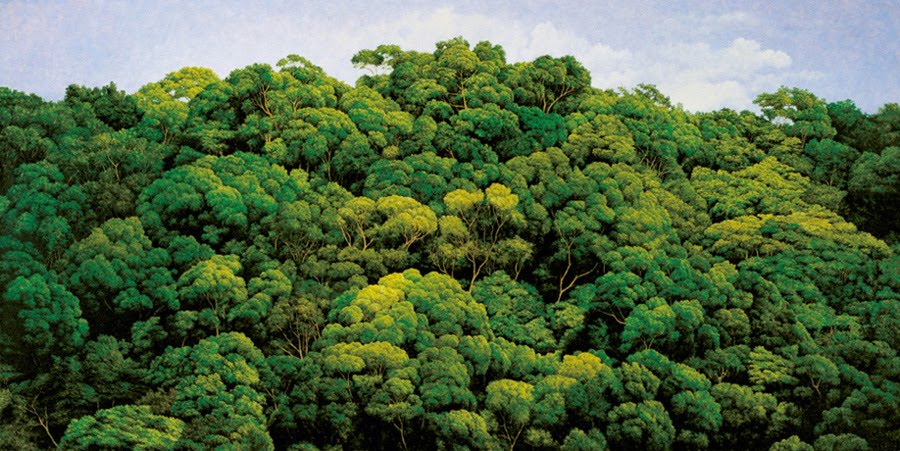
The ruins are now being swept from the face of history by the inexorable march of the jungle.
Red in tooth and claw

I, along with most of the UK, have been watching Saint Attenborough's new illuminated manuscript of slow motion marvel, Life. As we have come to expect, its the usual kaleidoscope of amazing sights, but this time, I am left underwhelmed...and for a reason that I am aware most people would disagree with. The premise of 'Life' actually appears to be 'Death' - every scene involves one animal hunting and then eating it's prey, obviously so that it might live.
The thing is, I really don't enjoy watching an endless procession of animals loudly crunching beetles in slow motion and ichor-dripping close-up. I know its a daily part of life and all that, my father was a large animal vet and I know how to kill and prepare animals, but it doesn't mean I'm too fond of watching a chameleon chomping a grasshopper in slow motion with ridiculously loud crunchy sound effects. And I certainly think there's little merit in the camera lingering over a group of komodo dragons begin to eat a live cow stuck in the mud, exactly as it happens in my worst nightmare.
I find it odd that the BBC finds it necessary to put sound effects on the slow motion footage. Why do they add the ridiculous noises? Does anyone really like hearing it? And if they want us to stare the reality of life and death in the face, why do they then give it a fake soundtrack?
Up close with nature
Boy would I like to do this!!! Don't know if I could sit that still though, I have a tendancy to laugh when exceptionally amazing things are happening
(and also when I'm in trouble, which wasn't a great help at school...)
Further Weirdness

No sooner do I post a potentially world-shattering piece of
time travel information,
when along comes something potentially even weirder. To paraphrase today's Telegraph:
A pair of German physicists claim to have broken the speed of light - an achievement that would undermine our entire understanding of space and time.
According to Einstein's special theory of relativity, it would require an infinite amount of energy to propel an object at more than 186,000 miles per second.
However, Dr Gunter Nimtz and Dr Alfons Stahlhofen, of the University of Koblenz, say they may have breached a key tenet of that theory.
The pair say they have conducted an experiment in which microwave photons - energetic packets of light - travelled "instantaneously" between a pair of prisms that had been moved up to 3ft apart.
Being able to travel faster than the speed of light would lead to a wide variety of bizarre consequences.
For instance, an astronaut moving faster than it would theoretically arrive at a destination before leaving.
- I don't know how I can cope with all this meddling with the universe going on in my daily broadsheets. The Guardian is going to have to pull something seriously bizarre out of the hat to top this. Perhaps some kind of story that links Toynbee to string theory, or Monbiot to an army of nanobots.
Food Terroir

I've searched all over the internet and I'll be blowed if I can find any form of scholarly information about a subject I was ruminating on this morning. I thought that perhaps if I post about it, one of my readers may know more!
Through the world of wine we are already au fait with the concept of terroir - the philosophy that states that a certain wine's flavour is rooted to one spot through a combination of environmental factors that cannot be replicated elsewhere.
The thing that I've been mulling over is related to this but concerning meats, herbs and vegetables.
Namely - does terroir extend to the way that plants and animals in a certain area seem to compliment each other perfectly?
For instance, how is it that the ideal and complimentary herb for lamb, rosemary, also happens to grow in the very places that only sheep seem to love - like the mountains of Greece? Why do those perfect plate-fellows, tomatoes and basil, grow side by side in Italy? In the mediterreanean they love fish, and what goes best with fish but lemons, which just so happen to grow in profusion around it's shores...
my examples are not very good, but hopefully you get my gist
Is there a word or a scientific explanation for this connectedness, this rootedness of flavour combinations? Or is it simply co-incidence?


Subscribe by RSS